Fire extinguisher inspection checklist
Updated August 2026
A print-ready fire extinguisher inspection checklist, free and login-free — the monthly visual check anyone on site can run, and the annual NFPA 10 maintenance a licensed technician performs. Add your shop name, then print it or save it as a PDF. It is a working checklist to adapt to the edition your jurisdiction enforces, never a substitute for it.
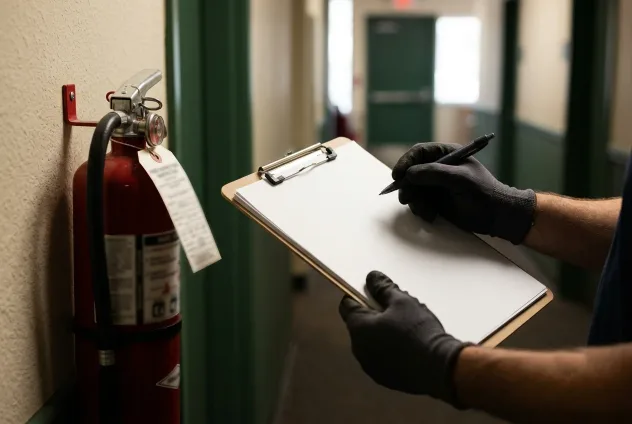
Two inspections, two clocks
"Inspecting" a fire extinguisher is really two jobs on two different schedules, and keeping them straight is the whole point of a good checklist. The first is the quick monthly visual check — a fast look anyone on site can run to confirm the unit is where it belongs, charged, and ready. The second is the annual maintenance — a hands-on service a licensed technician performs once a year under NFPA 10, ending in a fresh dated tag. The checklist below splits along exactly that line.
The monthly (30-day) visual check, item by item
Building staff walk the extinguishers on a regular, roughly 30-day schedule. You are not opening anything up; you are confirming, in a few seconds per unit, that it would work and that nothing has changed since the last look.
Start with placement: the extinguisher is in its designated location, visible, and its access is unobstructed. Read the pressure gauge — the needle should rest in the operable range, not the red on either side. Check that the pull pin is seated and the tamper seal is intact, then confirm there is no visible damage, corrosion, or leakage on the cylinder or valve. Look over the hose and nozzle to be sure they are intact and unclogged, and make sure the operating instructions are legible and facing outward. Finally, confirm the service tag is present and current; on wheeled units, also check the wheels, carriage, and hose. Anything out of place is written down and handed to a technician — you record it, you do not guess at it.
The annual maintenance, item by item
The annual maintenance is not a do-it-yourself item. It must be performed by qualified, licensed personnel per the applicable requirements: a full external maintenance — a hands-on examination of the mechanical parts, the extinguishing agent, and the expelling means, plus the gauge, the hose and nozzle, the shell, and the tag. The technician captures themanufacture date off the shell so the longer cycles are anchored correctly — the 6-year internal examination (for stored-pressure units) and the 12-year hydrostatic test (5 years for water, CO2, and wet-chemical units) are separate services triggered by the shell’s own dates.
When something is out of range it becomes a documented deficiency, not a shrug: a low gauge flags a recharge, an overdue shell flags a hydrostatic test, damage flags a repair or a replacement. The remedy is quoted and priced by you. The visit closes with anew dated tag that records the date, the result, the next-due date, and the technician and license — the small card a fire marshal reads first.
Record it, do not certify it
A checklist is stationery: it is where you record what you found and what you did. The determination of whether a site is in order rests with you, the licensed operator, and the authority having jurisdiction — never with a form. Keep each unit’s result on a dated, per-serial record and a lost or faded tag becomes an annoyance, not a gap.
Fire extinguisher inspection checklist
Monthly visual check · annual NFPA 10 maintenance
Monthly visual check owner or staff
- In its designated locationThe extinguisher is in its assigned place, visible, and its access is unobstructed.
- Pressure gauge needle in the operable rangeThe needle rests in the operable range, not the red on either side.
- Pull pin and tamper seal intactThe pull pin is seated and the tamper seal is unbroken.
- No visible damage, corrosion, or leakageThe cylinder and valve show no dents, corrosion, or signs of leakage.
- Hose and nozzle intact and uncloggedThe hose and nozzle are undamaged and clear of any blockage.
- Operating instructions legible and facing outwardThe nameplate and operating instructions are readable and turned to face out.
- Service tag present and currentThe dated service tag is attached and its date has not passed.
- Wheeled units: wheels, carriage, and hoseOn wheeled extinguishers, the wheels, carriage, and hose are in serviceable condition.
Annual maintenance licensed technician
- Performed by qualified personnelThe annual maintenance is not a do-it-yourself task — a qualified, licensed technician performs it per the applicable requirements.
- Full external maintenanceA thorough hands-on examination of the mechanical parts, the extinguishing agent, and the expelling means.
- Gauge and charge verifiedThe gauge reads true and the unit holds its rated charge.
- Manufacture date and cycles checkedThe date on the shell anchors the 6-year internal examination (stored-pressure units) and the 12-year hydrostatic test (5 years for water, CO2, and wet-chemical units).
- Deficiencies documentedAnything out of range becomes a recorded deficiency with a remedy — recharge, internal, hydrostatic test, repair, or replace — that you price.
- New dated tag attachedA fresh tag records the date, the result, the next-due date, and the technician and license.
Cadences vary by jurisdiction — verify with your AHJ.
Run the checklist on your phone, not on paper
GaugeRoute turns this walk into a guided pass-or-deficiency check per serialized asset, captures a photo-and-timestamp proof, and writes the dated tag record for you — offline, then synced. Free to start.
Frequently Asked Questions
- How often should a fire extinguisher be inspected?
- Two clocks. Building staff give each extinguisher a quick visual inspection about every 30 days, and a qualified technician performs a full external maintenance once a year. Requirements vary — verify the exact interval with your AHJ.
- Who can perform the monthly visual check?
- The building owner or staff can perform the quick 30-day visual inspection — confirming the unit is in its designated location, gauge in the operable range, unobstructed, and undamaged. The annual maintenance and any internal or hydrostatic service are not do-it-yourself tasks; they are performed by qualified, licensed personnel.
- What is the difference between the monthly check and the annual maintenance?
- The monthly check is a fast owner-level look that confirms the unit is present, charged, and ready. The annual maintenance is a hands-on professional service that examines the unit inside and out and ends in a fresh dated tag.
- Is this checklist a substitute for the NFPA 10 standard?
- No. It is a working checklist to adapt to the edition your jurisdiction has adopted, not a replacement for it. GaugeRoute records the inspection you perform; you and the authority having jurisdiction decide the status.