How often do fire extinguishers need inspection?
Updated August 2026Reviewed July 2026
"How often" has more than one answer, because "inspection" covers a few different jobs. Here is the way the trade actually breaks it down under NFPA 10.
The full version of this answer — with the cadence table for every extinguisher type — lives at how often fire extinguishers need to be inspected.
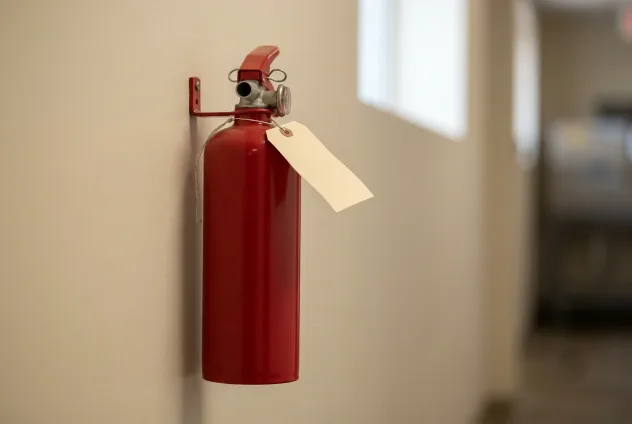
The quick visual check (owner level)
Between professional visits, the building's own staff give each extinguisher a fast look: is it in its place, is the gauge in the green, is the pull-pin and seal intact, is anything blocking it. Many authorities expect this on a regular, frequent schedule, and the exact interval is set locally.
The annual maintenance (professional)
Once a year, a licensed technician performs a full external maintenance: a hands-on check of the extinguisher's condition, the gauge, the hose and nozzle, the shell, and the tag. This is the every-12-months service that puts a fresh dated tag on the unit, and it applies to every extinguisher, whatever the agent inside.
The internal exam (every 6 years for most)
Dry-chemical stored-pressure extinguishers get an internal examination every 6 years: the unit is emptied, the inside inspected, and the agent and seals serviced. Some agents run on their own internal schedule, so the interval is keyed to the extinguisher’s agent type, not a single blanket rule.
The hydrostatic test (every 5 or 12 years)
The shell itself is pressure-tested on a longer cycle. Dry-chemical, clean-agent, and halon extinguishers are tested every 12 years; water, CO2, and wet-chemical (Class K) extinguishers every 5 years.
Kitchen and lighting run on their own clocks
Pre-engineered kitchen suppression systems are serviced semi-annually under NFPA 96 and UL-300. Emergency and exit lighting gets an annual full-duration test under NFPA 101. Both are separate schedules from the extinguisher lattice above.
Cadences vary by jurisdiction — verify with your AHJ.
Keep the dates on one record
Because each interval is keyed to the agent type and the manufacture date, a building rarely has one due date. Keep a per-serial record that anchors each cycle to the unit and generates the next date for you, then holds the dated proof of the service you performed. You and the authority certify the work; the record is there to prove it happened.
Frequently Asked Questions
- How often does a fire extinguisher get professionally serviced?
- Every portable extinguisher gets a full external maintenance once a year under NFPA 10, whatever the agent inside. That is the visit that puts a fresh dated tag on the unit.
- What is the difference between the 6-year and 12-year service?
- The 6-year service is an internal examination of most dry-chemical units; the 12-year service is a hydrostatic pressure test of the shell. Water, CO2, and wet-chemical units are hydrostatically tested every 5 years instead.
- Do building staff need to check extinguishers between visits?
- Many authorities expect a quick owner-level visual check on a frequent schedule, confirming the unit is in place, charged, and unblocked. The exact interval is set locally, so verify it with your AHJ.
Cadences vary by jurisdiction — verify with your AHJ.
Run the whole route in one place
GaugeRoute keeps every asset on its NFPA-keyed schedule, the inspection on the record, and the billing on your own rails. Free to start.