Fire extinguisher 6-year maintenance requirements
Updated August 2026Reviewed July 2026
The 6-year internal examination is the mid-life service between annual maintenance and the hydrostatic test. It applies to most stored-pressure dry-chemical extinguishers under NFPA 10.
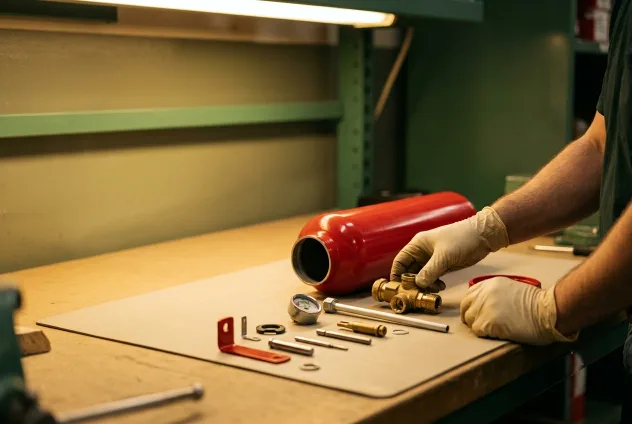
What the internal exam covers
Unlike the annual external check, the 6-year service opens the extinguisher up. The unit is discharged and emptied, the interior of the shell is examined, the agent is inspected and replaced per the manufacturer, the valve and internal parts are checked, the O-rings and gaskets are replaced, and the unit is recharged to its rated capacity and repressurized. A new verification-of-service collar goes on to record it.
Which extinguishers this applies to
The 6-year internal is the schedule for stored-pressure dry-chemical extinguishers — ABC, sodium-bicarbonate (BC), and Purple-K. Clean-agent and halon extinguishers also follow a 6-year internal cycle.
Agents that do not follow the 6-year cycle
The interval is keyed to the agent, and several agents differ. Water, CO2, and wet-chemical (Class K) extinguishers run on a 5-year clock for their shell testing rather than the 6-year dry-chem internal. Foam (AFFF / FFFP) extinguishers have their premixed agent replaced on a 3-year cycle, which serves as the internal service. Cartridge-operated dry-chemical units may take an annual internal instead of the 6-year one. Non-rechargeable (disposable) extinguishers get no internal exam at all — they are replaced 12 years from the manufacture date.
Because the right answer depends on the agent, the shell, and your adopted edition, treat these as the starting lattice and confirm the exact requirement per unit.
Cadences vary by jurisdiction — verify with your AHJ.
Anchor it to the unit
Anchor the internal cycle to each extinguisher’s manufacture date and agent type, and re-anchor it when you record the service. Your own date always wins; a per-serial record is the reminder, never the authority on the site’s status.
Frequently Asked Questions
- Which extinguishers need a 6-year internal exam?
- Stored-pressure dry-chemical units — ABC, sodium-bicarbonate (BC), and Purple-K — plus clean-agent and halon units. The service opens the extinguisher, examines the interior, replaces seals, and recharges it.
- Do water and CO2 extinguishers get the 6-year internal?
- No. Water, CO2, and wet-chemical units run on a 5-year hydrostatic clock instead, and foam units replace their agent on a 3-year cycle. The interval follows the agent, so confirm it per unit.
Cadences vary by jurisdiction — verify with your AHJ.
Run the whole route in one place
GaugeRoute keeps every asset on its NFPA-keyed schedule, the inspection on the record, and the billing on your own rails. Free to start.