Recharge vs. replace a fire extinguisher
Updated August 2026Reviewed July 2026
Every discharged, damaged, or overdue extinguisher raises the same question: recharge it or replace it? The honest answer is usually a quick piece of arithmetic on the unit’s remaining life.
When recharge is the call
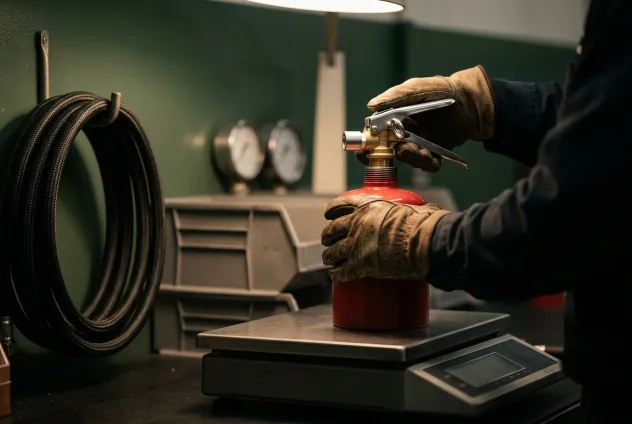
A rechargeable extinguisher that has been used, has drifted below charge, or is due for its internal service is a straightforward recharge: service the unit, refill the agent, and put a fresh tag on it. If the shell is sound and the next hydrostatic test is years out, recharging keeps a good unit in service.
When replace is the call
Replacement wins when the shell is at the end of its road or the unit was never meant to be serviced. Non-rechargeable (disposable) units are not serviced; they are replaced 12 years from the manufacture date. A shell that fails its hydrostatic test is retired, and one that would pass but is about to come due can be worth replacing now rather than paying to test an old shell you will retire soon anyway. Corrosion, a cracked valve, an illegible nameplate, or a discontinued agent can all tip the math toward a new unit.
The break-even question
The useful comparison is not recharge price against new price alone. It is the recharge plus the cost of the next internal exam and hydrostatic test, measured against a new unit that resets both clocks. On an old shell facing a near-term hydrostatic test, replacement often comes out ahead.
Is it cheaper to recharge or replace?
For a standard commercial dry-chemical unit, a recharge runs $15–$60 while a comparable new extinguisher is $40–$150 — so on price alone, recharge usually wins for commercial shells in good condition. The math flips for the light residential units sold at hardware stores: many are sealed, non-rechargeable by design, and even the rechargeable ones cost more to service than to replace. The rule of thumb a technician actually uses: rechargeable commercial shell inside its hydro window → recharge; disposable or damaged shell → replace.
When you don't get a choice
A recharge isn't optional after any discharge — even a two-second burst leaves the unit below spec and the gauge lying about it. Replacement is forced when the shell fails hydrostatic testing, shows corrosion or a damaged valve, or uses an obsolete agent that can no longer be serviced. And an old unit never goes in a dumpster charged: the cylinder is pressurized. A fire-equipment company will take it, and many fire departments run drop-off days.
Turning the call into a clean line item
Whichever way it goes, the deficiency becomes a documented remedy: recharge, internal, hydrostatic, or replacement, each a line you can quote. You set the price; the customer sees exactly what and why.
Cadences vary by jurisdiction — verify with your AHJ.
Frequently Asked Questions
- When should a fire extinguisher be replaced instead of recharged?
- When the shell fails or is near its hydrostatic due date, when the unit is non-rechargeable (replaced 12 years from manufacture), or when corrosion, a cracked valve, an illegible nameplate, or a discontinued agent tips the math toward a new unit.
- How do I decide recharge versus replace on cost?
- Compare the recharge plus the next internal exam and hydrostatic test against a new unit that resets both clocks. On an old shell facing a near-term test, replacement often wins.
- How much does it cost to recharge a fire extinguisher?
- Typically $15–$60 per unit depending on size and agent, plus a service visit or drop-off. Specialty agents (clean agent, Class K wet chemical) run higher.
- Can you recharge a fire extinguisher yourself?
- No — recharging requires weighing, agent handling, and repressurizing to spec with the right equipment, and NFPA 10 expects certified servicing. DIY kits don't produce a unit you can trust or document.
- How many times can an extinguisher be recharged?
- There's no fixed count — a commercial shell can be recharged for as long as it keeps passing its six-year maintenance and hydrostatic tests.
Cadences vary by jurisdiction — verify with your AHJ.
Run the whole route in one place
GaugeRoute keeps every asset on its NFPA-keyed schedule, the inspection on the record, and the billing on your own rails. Free to start.